Posts

4th Sunday of Lent (C)
Image
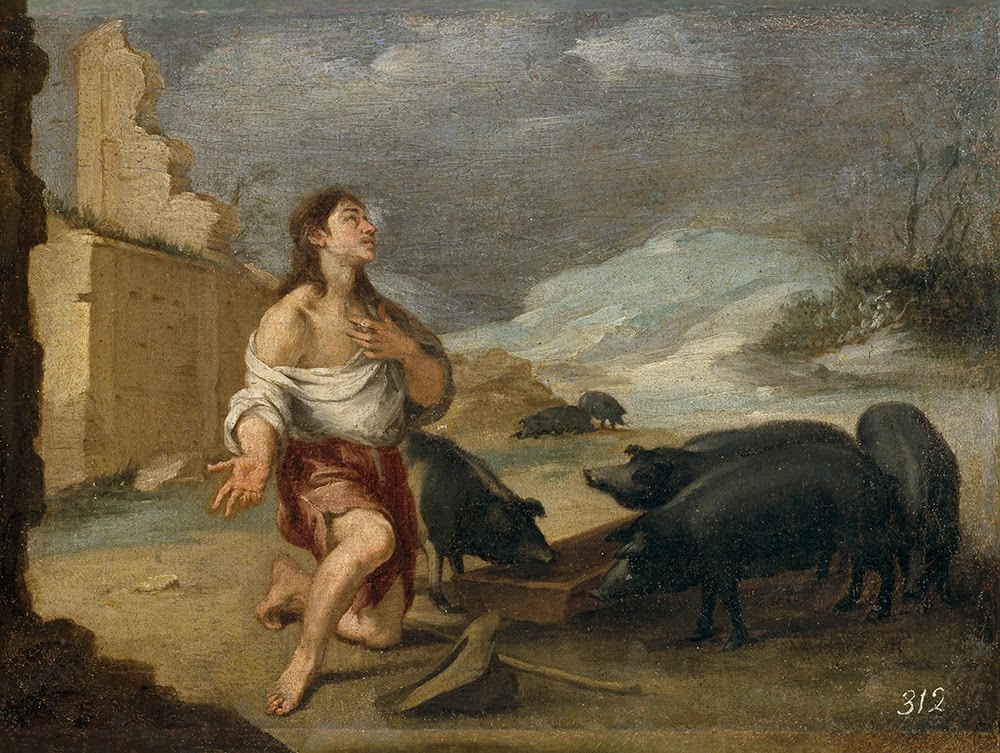
Without a doubt, the parable we have just heard is the most famous parable Jesus ever preached – that of the Prodigal Son. It has captured hearts and inspired imaginations down the centuries, and it speaks ever so powerfully to us today. Part of what makes this parable widely compelling comes from how easy it is to see ourselves in any of its characters: the son who squanders his inheritance, the father who forgives, or the brother who resents both. As we see ourselves in the characters, we can also read particular sins into the very center of the narrative. Whatever the younger son may have done to waste what his father gave him can easily stand for our own sins or the sins of our loved ones.  The sins from our own experience that we read into this parable, however, tend not to be the superficial or inconsequential ones but, on the contrary, those that are deep and damaging. We don’t compare the sin of the prodigal son to the little white lie we told when we were twelve; nor do we...
3rd Sunday of Lent (C)

Image
Does God want us to be happy? We may instinctively say, “Yes, I know God wants me to be happy,” but our day-to-day experience of being unhappy (in whatever form that takes for each of us) may lead us to think otherwise. We might try to explain away our unhappiness in the present moment in one of two ways. Perhaps we believe that God wants us to be happy, but he won’t let us be happy because of our sins. Or, perhaps we think that God wants us to be happy, but only in the next life and not in this one. When I’m feeling blue, I tend to put both together and think that God won’t let me be happy because of my sins, but happiness will be my reward in the life of the world to come – please God, I make it there.  Each of these attempts to explain the reality of our unhappiness despite God’s desire for us to be happy are, what we call half-truths. Taken as absolutes they’re false, but there’s a hint of truth in them. That hint of truth, however, is mixed with insidious lies – lies that the ...

2nd Sunday of Lent (C)

Image
I’m sure we have all wondered what heaven will be like. From the time that we first heard the Gospel and came to know the promise of eternal life, we have all carried with us some conception, however faint, of what heaven, our eternal reward, will be. Up and down the centuries, theologians and poets, musicians and painters, and all the rest have sought to describe the contours of heaven, inviting us to ask who will be there, what will it look like, what will we do, and similar questions.  Some years ago, I came across a novel that offered me less of a description of heaven than it gave me a new way of thinking about it. That book was Marilynne Robinson’s Gilead , which won the Pulitzer Prize in 2005. Gilead is the memoir of an old preacher named John Ames in which he reflects on his long life and ministry. John Ames is close to death and thus sets out to write a lengthy letter to his seven-year-old son to read after he passes, and his son is old enough to comprehend all the things...

1st Sunday of Lent (C)

Image
We are well aware that the season of Lent is about turning away from sin. This past Wednesday, we were told to “Repent and believe in the Gospel”, and we have hopefully all made a resolution to root out some kind of sin from our life over the next forty days. But for us to stop sinning, we have to understand why we sin in the first place. Otherwise, we’ll simply keep spinning our proverbial wheels in the mud. Why do we sin? That is a question that we each must ask for ourselves in the quiet of our heart, as we each have our own reasons for being drawn to one sin or another. We believe, however, that the light of Christ reveals to us our humanity, and that applies both to us in particular as individuals and in general as a species. Thus, we ought to seek to discover how that light, which reaches us today through the Scriptures we have heard, reveals us to ourselves and helps us understand in particular and in general why we sin.  I propose to you the following thesis: We sin because...

8th Sunday of the Year (C)

Image
The Church is about to embark, beginning this Wednesday, on her annual “campaign of Christian service” which we call the season of Lent. We will undertake voluntary acts of prayer, fasting, and almsgiving. We will set firm resolutions to give something up or to adopt a new charitable practice among the works of mercy. We will deprive ourselves of various pleasures and delights. We will strengthen our resolve to turn away from sin and to be faithful to the Gospel.  We will do all of this because we desire to change. We know that we are not what we should be, and we’re grateful that the Church gives us this season of Lent each year for us to work on ourselves. And yet, however great our determination may be to make this Lent matter, chances are in the coming weeks we will quickly find ourselves struggling to keep even the smallest of those resolutions. Somewhat frequently, I go without eating breakfast or lunch; sometimes the day carries me from one thing to the next and I don’t eve...

7th Sunday of the Year (C)

Image
In the wake of the Super Bowl, I’d like to begin this morning’s homily by making reference to one of the greatest press conferences ever given by a sports personality. In 2002, Herm Edwards, then the coach of the New York Jets, famously told the camera: “You play to win the game. You don’t play it just to play it… You play to win the game!”  What Coach Edwards said about football is also true of the Christian life. The reason we play the game––that is, why we live the Christian life, with all of its demands––is to win the game, to be saved. As with any game, in order to win, you have to follow certain rules, and Christianity is no different. In the twelve verses of today’s Gospel, Jesus lays down, on my count, seventeen such rules: love your enemies, do to others as you would have them do to you, be merciful, et cetera. Elsewhere, Jesus instructs us that we need to keep his commandments to remain in his love (cf. Jn. 15:10) and that, if we remain in his love, he will come again and...

6th Sunday of the Year (C)

Image
You may recall that 2020 was a rather difficult year. Of course you do. We could all tell our stories about how the beginning of the pandemic impacted us, as our world and our lives were turned upside down. I’d like to share with you something that happened to me in that time––and I apologize that I’m about to talk a lot about myself, but I ask you to trust me that it’s for good reason.   As the world shutdown in March, I was quickly brought home from Rome to finish my semester virtually. At the same time, I was also assigned to live at my home parish, which at that time had neither the capacity for livestreaming Mass nor the leadership of a pastor, since ours had died suddenly in the previous fall. On top of all that, there were three other seminarians assigned to live with me in the rectory, two of whom had just started learning English. So, amidst all of this, I found myself to be part-time: grad student, parish administrator, video editor, seminary formator, housekeeper, and la...